History of Cologna Veneta - Corte delle Giuggiole
The countryside southeast of Verona and a few kilometers from the Berica area is home to a small town of about 9,000 inhabitants that has had many wartime travails over the centuries.
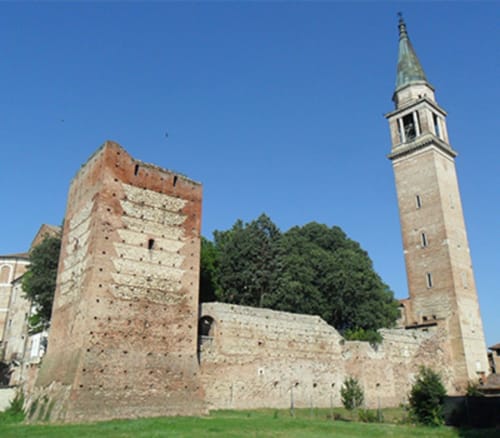
The origin of the town seems to come from very far away, as attested by the discovery of artifacts in a necropolis near Santa Giustina in the hamlet of Baldaria, a few kilometers from our farmhouse with lodging, which tell us that it is likely that the area on which Cologna Veneta stands was inhabited as early as the end of the fifth millennium BC. The Euganeans first (1000 B.C.) and then the Veneti (700 to 400 B.C.) anticipated the arrival of the Romans (1st century B.C.) with whom it became part of the Atestino agro of Este (PD), a town at the foot of the Euganean Hills. There are remnants of centuriation to the east of the town, in the area where our agriturismo Corte delle Giuggiole is located, where, after the Battle of Actium (31 BC) between Mark Antony and Octavian (civil war after the death of Julius Caesar), some veterans of the civil war settled in the Colognese.
In 600 AD. Cologna Veneta became Lombard and was part of the Duchy of Vicenza; in 1239 it fell into the hands of Ezzelino III da Romano, powerful dictator of the upper Vicenza area to whom it attempted to rise up with Jacopo Bonfado in 1256 but with disastrous results.
In 600 AD. Cologna Veneta became Lombard and was part of the Duchy of Vicenza; in 1239 it fell into the hands of Ezzelino III da Romano, powerful dictator of the upper Vicenza area to whom it attempted to rise up with Jacopo Bonfado in 1256 but with disastrous results.
In 1406 the then Doge of Venice Michele Steno decreed the aggregation of Cologna Veneta to the Dorsoduro Sestiere of Venice, which it remained until the fall of the Serenissima (1797).
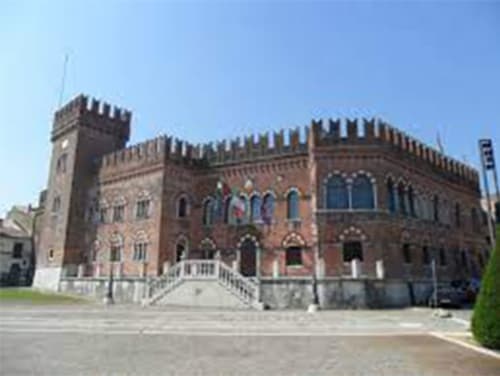
In the middle of the town, the Gua River flowed until 1904, but after yet another flood (1882), the town authorities decided to divert its course, and during excavations, numerous prehistoric artifacts were found that allowed the creation of the Civic Archaeological Museum of Cologna Veneta.
Near the farmhouse it is possible to see what remains of the Treviso - Ostiglia railway, inaugurated in 1925, and the Cologna Veneta station remained in operation until 1967 for passenger service and until 1987 for freight service.
Almond of Cologna Veneta
Cologna Veneta is known in Italy and abroad for Mandorlato, a refined Christmas dessert.
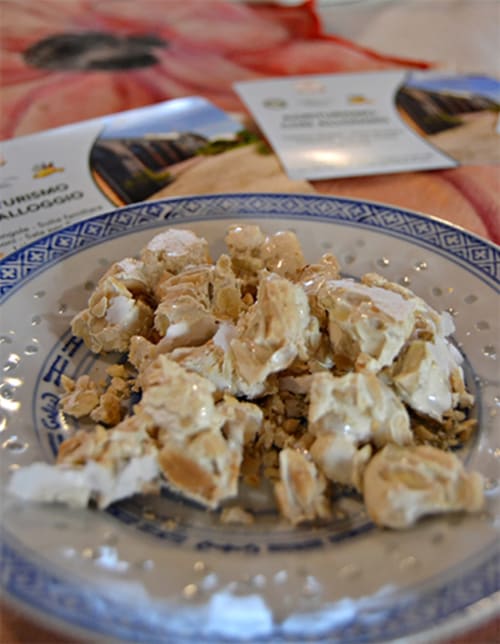
The certain date of the invention of this sweet is not known. It is credible that mandorlato was known and appreciated as early as the time of the Serenissima Republic. An early reference to mandorlato can be found in Lodovico Dolce's text in 1540.
In 1564 a Vicenza nobleman of the Monza family left written about the purchase of mandorlato in his "journal-book." Other writings on Cologna Veneta's mandorlato were made by Alvise Zorzi, a Venetian writer and nobleman, Pompeo G. Molmenti, Samuele Romanin and others.
A characteristic that distinguishes mandorlato from other types of nougat is its extreme hardness and friability. These characteristics are described as early as in a letter, dated 1778, which recounts an incident that occurred to a former Jesuit.[6]. Giulio Cardo, a well-known historian from Colognese, noted thus, "19th century - Finco dr. Antonio di Giovanni Battista, was a man very well versed in science, especially in chemistry and botany invented a recipe..." with which it is still made today Modern production of almond cake began in 1852 with Italo Marani.
Today there are several firms that produce it, both industrially and artisanally.
Four are the typical ingredients for its manufacture: almonds, honey, sugar and egg white. The dosage and the precise observance of the intervals established to input the various ingredients, are indispensable without forgetting, finally, the temperature that must be constant throughout the eight hours or so needed for perfect baking.
In 1564 a Vicenza nobleman of the Monza family left written about the purchase of mandorlato in his "journal-book." Other writings on Cologna Veneta's mandorlato were made by Alvise Zorzi, a Venetian writer and nobleman, Pompeo G. Molmenti, Samuele Romanin and others.
A characteristic that distinguishes mandorlato from other types of nougat is its extreme hardness and friability. These characteristics are described as early as in a letter, dated 1778, which recounts an incident that occurred to a former Jesuit.[6]. Giulio Cardo, a well-known historian from Colognese, noted thus, "19th century - Finco dr. Antonio di Giovanni Battista, was a man very well versed in science, especially in chemistry and botany invented a recipe..." with which it is still made today Modern production of almond cake began in 1852 with Italo Marani.
Today there are several firms that produce it, both industrially and artisanally.
Four are the typical ingredients for its manufacture: almonds, honey, sugar and egg white. The dosage and the precise observance of the intervals established to input the various ingredients, are indispensable without forgetting, finally, the temperature that must be constant throughout the eight hours or so needed for perfect baking.